This post from DuckDuckGo [https://spreadprivacy.com/google-filter-bubble-study/] explains their methodology for investigating self-serving bias in Google searches. Simply put, the approach asked different individuals from different locations to execute the same searches. This was done with and without enabling privacy mode. The dependent variable was the top searches returned and these hits were analyzed using a procedure that measured the uniqueness of the hits. I have tried to approximate what I thought such a methodology would be using open and private mode without much finding much difference. The DuckDuckGo results explain why this might be as even private mode showed bias. Another difference was probably the search term used. I used apple (would one see computers or fruit). They used vaccinations, gun control, and immigration.
It would be interesting to duplicate this methodology and add different search engines as an additional variable. This would be a nice project for a college course.
Showing posts with label google. Show all posts
Showing posts with label google. Show all posts
Friday, February 15, 2019

Monday, November 19, 2018
Dead Google+ Walking
Google+ has been sunsetted and will be shut down in about 9 months. The idea of sunsetting is to allow users to abandon a service so they can't complain about not being told the end is near. Most users abandon immediately leaving a few die hards to soldier on.
I liked Google+ and thought the early version had great educational promise. It allowed a user to create circles which were an effective way to communicate that we have partially overlapping personal relationships in our lives and we communicate in different ways and about different things with those in different circles. The opportunity to protect student users was obvious. It offered Hangouts and later Hangouts on air which was an early group video meeting site I found very useful for my grad online classes. The Hangouts On Air allowed me to save class meetings to YouTube which was important for those who were unable to attend class. It, surprisingly, did not include ads. I know - weird for Google, but also a plus for educators.
Some argue that the entire thing began to fall apart in 2014 when Vic Gundotra left Google. Gundotra championed Google+ in a vain attempt to move Google into social. I agree with the author of the post I link here claiming that Google+ was superior to Facebook, but it never attracted enough users to reach critical mass and failed to continue development allowing Facebook to mimic many of the advantages originally developed by Google.
I think the online world is better off when there are options and competition. Perhaps with all of the problems no associated with Facebook, Google pulled the plug a little too early.
Sunday, May 20, 2018
The end of "Don't be evil"
Google has decided to “downgrade”
“Don’t be evil” in its employee code of conduct. I always liked the
Google story and the original directive to its employees. It seemed a
positive message and a laudable goal. From my perspective, Google is
still less evil than the others in the big four (Amazon, Apple,
Facebook, Google).
Citizens of the U.S. seem to be struggling with the ethics of unbridled capitalism. We live in a society that has come to question the equity of our system. It turns out that everyone does not actually have the same opportunities and our politicians are embracing the failed model of trickle-down economics moving tax dollars from the needy to large corporations. The Internet itself is no longer open with the removal of the provision preventing the companies that control our access from the opportunity to control that access often leaving citizens no opportunity to seek an alternate provider. Now, we must deal with the end of don’t be evil.
We are partly at fault. We have embraced the false promise of free. We should have known better. Most of us would seem capable of processing the impossibility of providing services and hiring employees of great talent without an obvious source of income. Yes, we saw a few small ads, but few of us ever clicked on those ads. We should have known better.
Perhaps reality has now set in. Given that “free” is an illusion, what should we expect now? Probably, the best we can hope for is transparency. Trading the record of our online behavior to Google for ads that are consistent with our interests AND free services seems a reasonable deal. Companies that collect this information and sell it to other companies is not (Facebook).
Government oversight is presently confused with socialism. People seem confused by the promotion of economic principles that are argued to be open, but are really not when examined more closely. We need regulation that actually allows for equitable competition. I am still a Google fan, but the downgrading of “Don’t be evil” is a sign of the times.
Citizens of the U.S. seem to be struggling with the ethics of unbridled capitalism. We live in a society that has come to question the equity of our system. It turns out that everyone does not actually have the same opportunities and our politicians are embracing the failed model of trickle-down economics moving tax dollars from the needy to large corporations. The Internet itself is no longer open with the removal of the provision preventing the companies that control our access from the opportunity to control that access often leaving citizens no opportunity to seek an alternate provider. Now, we must deal with the end of don’t be evil.
We are partly at fault. We have embraced the false promise of free. We should have known better. Most of us would seem capable of processing the impossibility of providing services and hiring employees of great talent without an obvious source of income. Yes, we saw a few small ads, but few of us ever clicked on those ads. We should have known better.
Perhaps reality has now set in. Given that “free” is an illusion, what should we expect now? Probably, the best we can hope for is transparency. Trading the record of our online behavior to Google for ads that are consistent with our interests AND free services seems a reasonable deal. Companies that collect this information and sell it to other companies is not (Facebook).
Government oversight is presently confused with socialism. People seem confused by the promotion of economic principles that are argued to be open, but are really not when examined more closely. We need regulation that actually allows for equitable competition. I am still a Google fan, but the downgrading of “Don’t be evil” is a sign of the times.
Thursday, May 3, 2018
Google Photos lens (not yet on iOS)
Google offers a very useful image investigation tool called lens. Using Google Photos you can find out information about the images you have collected with your phone.
Here is a quick description of how this tool might be used.
We just returned from a trip to Rome where I took this picture. I had no idea what I was looking at when I took the picture or afterward. I brought this image up on my chromebook with the Google Photos app installed and selected the lens tool at the bottom of the image and generated the information appearing in the second image. Google identified the image as showing the Theater of Marcellus and provided a link to information from Wikipedia.


Apple iOS announced that it would provide the same service (March 16), but I am still waiting (the information icon appears where the lens app should be).

This tool should offer learners some interesting opportunities.
Monday, January 29, 2018
YouTube, the long tail, and don't be evil
On Feb. 20, the rules for participation in the YouTube Partner Program will change. Among the benefits of being a partner was the opportunity to earn revenue from the ads that run when a Youtube video is displayed. Before this date, a creator became eligible for ad revenue once he/she had accumulated 10,000 lifetime views. After this date, you must have 4000 hours of viewing time in the last running 12 month period and 1000 subscribers.
Google indicates that the change will:
"will allow us to significantly improve our ability to identify creators who contribute positively to the community and help drive more ad revenue to them (and away from bad actors).”
I am the type of creator that will be penalized by this change. I meet the 10,000 view metric, but fail both the 4000 hours and 1000 subscriber standard.
I am not a bad actor. I post instructional videos for educators wanting to use technology applications in their classrooms. I have a couple of textbooks devoted to this goal, but made the decision several years ago to create much smaller and less expensive textbooks (available via Amazon) in combination with free online resources (supplemental information and instructional videos). The price when my textbook was last published by Cengage was $140. The Amazon price is now $9 and the Kindle combination with the online resources offers more and more current content than the $140 version.
I originally offered the video content I created from the server I rent. As more and more content was added, I became concerned with the load serving the video required. Moving the content to YouTube was a way to avoid this issue, to offer content to those who had no interest in my other educational products, and to make a little money (a few dollars a month when my instructional videos are viewed). Just for the record, when my YouTube video is embedded within a web page I serve, viewing the embedded video generates no revenue.
Consider the reality of reaching the 1000 subscribers and 4000 hour thresholds. Nearly all of my videos are say 8-10 minutes in length. Several are recommended by YouTube and have been viewed in the 1.5K range. Still, my estimate is that my annual viewing time would be about 18,000 minutes (YouTube analytics are reported in minutes). This is a long way from 240,000. I also do not have a lot of subscribers. People come to my individual videos when searching for a particular need or perhaps when assigned by a college professor. I make no effort to continually create videos which is what tends to attract and hold subscribers. I create videos when the issue or product presented fits an instructional need related to my other content. I could continually create videos on the many similar products available to educators but the replication in this approach has little benefit.
The YouTube decision fits a disturbing trend I see with tech service providers. The initial promise that all could become creators (this was what Chris Anderson described as the long tail) has given way to only the big content generators will be supported. The few dollars YouTube might compensate me is of little actual consequence, but the cost to YouTube was also quite minimal. It is the principle here that is disturbing (see Rushkoff’s “Throwing rocks at the Google bus”).
Saturday, July 22, 2017
YouTube Editing Capabilities to Change
Google has announced that the editor and slide show tools are being removed as of September. These are capabilities that are attractive in schools because the video tools cost nothing to use. A notice now appears when these tools are opened to make users aware of the coming changes.


Wednesday, August 17, 2016
Here comes change - again
We made the decision some 5-6 years ago to abandon the traditional textbook model. We felt most textbooks were too quickly dated and this was certainly the case for those of us who write about the educational uses of technology. It was more than this. We proposed that authors combine a core textbook (we called it a Primer) with online resources. This now happens on a primitive basis with many textbooks, but the commitment to this hybrid approach is what the textbook companies do not fully understand. Yes, some content is best presented online and flexibility and multimedia are available when a company commits to combining a book and online content. What textbook companies do not want to do is support authors who write continuously. Because of the editing and production process, books are dated by the time they are actually printed. In order to combat this reality, we argued that proven authors should be paid to write continuously. Meeting a delivery date and then waiting to be given the approval to develop new content until a new edition is approved three years later is not good enough. Even after multiple successful editions, it was this factor that led us to break away from Cengage some years ago.
The other side of this is that as an author you have to be willing to back up your commitment. I understand this issue as a faculty member and as an author. I use our Kindle book and other resources in the graduate course I teach. While the course that will begin in a week or so draws students from various backgrounds, the course is focused on the use of technology in K-12. The university supplies me with great tools for teaching online (e.g., Blackboard, Adobe Connect with a phone bridge), but I try to make reasonable use of online tools that some might regard as less sophisticated. How educators learn with technology influences how they will teach with technology. Most K-12 districts will not be in a position to make Adobe Connect or a phone bridge available to their students.
One of the tools I have used in past courses has been Google Hangouts on Air. In smaller summer courses, I could use this tool for the synchronous portion of the course. I could send the recording of the classes to YouTube for those students who could not participate in the live class because of geography or an occasional conflict. Hangouts on Air was available to anyone and the educators in my class could use the same tool to link their classroom with others. [Maybe I should explain a phone bridge. As the phrase implies, a phone bridge uses phone audio rather than VOIP. You just cannot count on all students having sufficient bandwidth for quality audio and the audio stream ends up being most easily degraded in a way that influences the quality of interaction. A phone bridge creates what is essentially a giant conference call synched to the other resources and perhaps the audio fed from a traditional classroom.]
So, I am a week away from starting the Fall semester. The syllabus is ready to go and students have had the opportunity to take a look at what will be expected. I learn that in September Google will eliminate Google Hangouts on Air as it presently exists and wants users to move to Youtube Live Stream. The timing and the brief lead time here are problematic. I must say that Google has eliminated several tools that I thought were great. Google Reader comes to mind. I need to heed my own advice and not complain about free.
This has happened so quickly that I have not really had the time to fully research the new option. I thought Hangouts on Air was great because it was simple to use, easily saved content to YouTube, and made use of Google Circles which I thought was a great way to provide a reasonable level of access and security. The content available explaining the new opportunity seems very sketchy at present. There are more settings to consider and it seems this is more focused on a concept emphasizing broadcast rather than group interaction. I will wait a bit before developing new tutorials, but it seems it is down to delete the present content on Hangouts.
Saturday, May 21, 2016
Wide open SPACES
Google just released a new social media service - Google Spaces. I am reluctant to go all in on Google products because I have been burned too many times. I find services interesting, put in my time developing something, and then the service is abandoned. This the Google way and Google users should know this pattern, but there is also the issue of promoting a Google service and then finding you have advocated that others spend their time before it is clear Google is really serious.

So, again, this service looks interesting and worth a look. My first paragraph should offer fair warning. If you would like to check out a simple resource, here is a link for a simple space I have created requesting input on experience with formatting for Kindle publication. You do not have to be interested in the topic to take a look.
My initial interpretation is that Spaces offers a way to generate a conversation around a topic. If my interpretation is accurate there should be some value in this approach. My immediate reaction is that this could be an improvement on the popular Twitter chat which I see as hampered by the limited commenting that Twitter allows.
As I understand the present situation, Spaces is not a Google for Education app. I would guess this will change as the services seem well suited to posting questions, content for discussion. This will likely change.

Here is what I am missing about what Google is thinking. When you create a Space you invite access. These are the options. Why Facebook? Why not use Circles which I thought was a very interesting and useful approach to controlling access? Sending a link has limitations when it comes to controlling access. The link can be easily shared without consent of the personal creating the Space.
Wednesday, April 20, 2016
Google Save
I am satisfied with my present systems of archiving bookmarks and images, but Google has just announced a new service that may interest others.
Google Save makes use of a Chrome extension to bookmark sites and has included a Save to Google Save button in the Google images site.
The extension for bookmarking is available at https://chrome.google.com/webstore/detail/save-to-google/meoeeoaohbmgbocpdpnjklmfmjjagkkf. The install adds an icon to the tool bar.

Clicking this icon will add a representation of the page being viewed to Google Save (see below).

Entries can be tagged for more efficient search. Selecting the saved representation of a site produces a larger display with additional information. Selecting the site URL takes you to that site.
Saving images a little differently. Images are available from https://images.google.com. Searching this site brings up images associated with the search term and selecting one image produces the following display. This display now includes a button that will save the image to Google Save (beware copyright issues in using the images).
I do not consider the present version of Google Save to be equal to the features of my present tools, but the service is free and would seem helpful when collecting resources for a project. Improvements would be required for me to consider the service as a way to collect resources long term.
Wednesday, January 13, 2016
Google Photos search
I created a Google Photos account as a backup to my Flickr account, but I am discovering that Photos has some unique capabilities. I realized that it classified your photo library in various ways, but I did not know you could search for words describing specific images as if you were searching for words.
I was attending a FETC session and the search capability was demonstrated. The presenter searched for pizza. I tried the same thing.

I have been working with tech since the mid 80s and I still am amazed.
Thursday, November 19, 2015
Google+ Collections
Google+ offers a service called collections which seems a great way for an educator to organize Google+ posts to share. These can be personal posts or posts publicly shared by others. Collections offers the same sharing scheme Google uses with other social resources and this approach would allow an educator to limit access to a given collection to a designated "circle". So, the educator could set up a collection for a specified group of students or colleagues.
The following video demonstrates the creation of a collection and the process of adding posts to that collection.
Friday, July 31, 2015
Cloudbooks
I have to admit the concept of a "cloudbook" is new to me. I can tell because my browser still thinks the word is misspelled. Tech journalists I follow started mentioning cloudbooks after the release of Windows 10 and it is reported that the new devices will be available for well under $200.
So a cloudbook will have an OS other than chrome and will be priced lower than a chromebook. I guess I am not certain how this will work. How much do the companies have to pay Microsoft for the OS. I assume the logic would be that users are not totally dependent on online services, but then what will be the cost of this additional software and how can the combination of Windows and other software be less expensive than a Chromebook?
I understand the challenge Google presents to other providers when it comes to inexpensive hardware and software, but how will companies who make their money selling software compete. Google can generate revenue from ads.
Monday, July 20, 2015
Google's Mobilegeddon
I cannot claim credit for labeling Google's prioritization of what they define as optimized content for mobile as "Mobilegeddon", but I am impacted by this decision. Mobile content pretty much requires "responsive" web sites that recognize what type of device is requesting content and adapts accordingly. Much of my content does not meet these expectations. The consequence is that the ranking used when my content comes up in a search is decreased and readers are less likely to find my content. For me, the ideal solution would be tedious and time consuming. Blogs can be upgraded through the use of a different theme. Web pages may have to be redone individually.
Google did give those of us offering content time to make modifications and ways to evaluate whether our content met their expectations. I suppose they are looking at the numbers. I am not concerned that my "long form" content would appear ranked lower when a search is conducted from a phone. I only read long pieces on my phone to say that I have done it. I am a bit frustrated that an iPad seems regarded as a "mobile device" as my impression is that my content looks fine on an iPad and whether the pages are responsive or not is not really an issue. It seems one of those policy decisions based on a premise that was only partly implemented. If device is to be a variable in ranking, then decisions made taking device into account should be made in a more sophisticated manner.
Here is the Forbes take on Mobilegeddon.
BTW - One of my methods of adjusting to the Google policy is to cross post my posts. Blogger blogs meet standards (as one might expect), but many Wordpress blogs do not.
Wednesday, July 8, 2015
Backup, synch, or both
A high proportion of posts to Google+ I encounter seem related to issues with Google Photos. I have not invested a great deal of time in figuring out Photos beyond uploading several thousand picks. I do think the Google documentation needs to be improved.
Aside from concerns related to partial uploads, it seems to me many of the questions could be described as uncertainty regarding whether Google is providing customers a backup or synch service. Customers are concerned that they want a backup and are worried Google may be providing synch. In other words, customers are concerned that if they delete photos on the local device, the photos will then be deleted in their Google account leaving them with no copy anywhere.
Google provides a help comment on synch vs. backup, but this distinction appears to only apply with mobile devices. I would guess most folks with really large photo collections are trying to figure out what applies to their desktop machines.
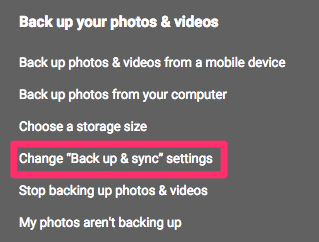
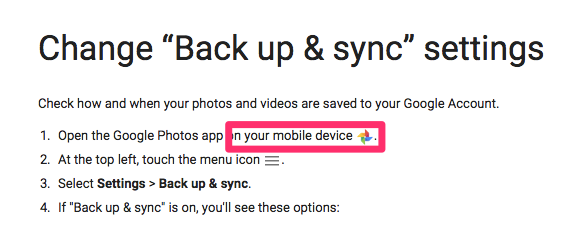
So Google, if you encounter this post, you might cut down on the frustration and confusion if you would clarify the differences between your mobile and desktop services.
Monday, July 6, 2015
Research shows Google search bias?
It seems to be Apple and Microsoft against Google. The “concern” expressed by the unlikely pairing of Apple and Microsoft is that Google collects, and as I understand all of the concerns, shares personal data for pay. Google, in response, argues they use the information collected as a way to improve the search experience.
While this sounds like an disagreement over a principle, the positions taken align with business interests. Google makes money from advertising. Apple makes money from hardware. Microsoft makes money from software. The income foci of these companies has evolved and this may have something to do with the positions now taken on privacy. Google offers software and services for free partly to increase use of the web and as a way to offer more ads and collect more data. Google also offers services that decrease the importance of hardware. Chrome hurts the hardware sales of Apple.
What I think is important under these circumstances is clear public understanding of what data are being collected, how it is being used, and what are the motives of the players involved. It turns out we all are also players because blocking ads while still accepting services (the consequences of modifications of browsers) involves personal decisions for what constitutes ethical behavior.
Into this business struggle and how it has been spun appears a recent “study” from Tim Wu and colleagues. Evaluation of the study is complicated by the funding source - Yelp. Yelp has long argued their results should appear higher in Google searches and suggests Google elevates the results of Google services instead. Clearly, you or I could go directly to Yelp when searching for local information completely ignoring Google (this is what I do when searching for restaurants), but Yelp wants more.
I have a very small stake in Google ads (making probably $3-4 a year), but I am more interested in the research methodology employed in this case. My own background as an educational researcher involved the reading and evaluation of many research studies. Experience as an educational researcher is relevant here because many educational studies are conducted in the field rather than the laboratory and this work does not allow the tight controls required for simple interpretation. We are used to evaluating “methods” and the capacity of methods to rule out alternative explanations. Sometimes, multiple interpretations are possible and it is important to recognize these cases.
Take a look at the “methods” section from the study linked above. It is a little difficult to follow, but it seems the study contrasts two sets of search results.
The Method and the data:
The method involved a comparison of “search results” consisting of a) Google organic search results or b) Google organiic search results and Google local “OneBox” links (7 links for local services with additional information provided by Google). The “concern” here is that condition “b” contains results that benefit Google.
The method involved a comparison of “search results” consisting of a) Google organic search results or b) Google organiic search results and Google local “OneBox” links (7 links for local services with additional information provided by Google). The “concern” here is that condition “b” contains results that benefit Google.
The results found that condition B generate fewer clicks.
Here is a local search showing both the OneBox results (red box) and organic results from a Minneapolis search I conducted for pizza. What you see is what I could see on my Air. Additional content could be scrolled up.

The conclusion:
The results demonstrate that consumers vastly prefer the second version of universal search. Stated differently, consumers prefer, in effective, competitive results, as scored by Google’s own search engine, than results chosen by Google. This leads to the conclusion that Google is degrading its own search results by excluding its competitors at the expense of its users. The fact that Google’s own algorithm would provide better results suggests that Google is making a strategic choice to display their own content, rather than choosing results that consumers would prefer.
Issues I see:
The limited range of searches in the study. While relevant to the Yelp question which has a business model focused on local services, do the findings generalize to other types of search?
What does the difference in click frequency mean? Does the difference indicate as the conclusion claims that the search results provide an inferior experience for the user? Are there other interpretations. For example, the Google “get lucky” and the general logic of Google search is that many clicks indicate an inferior algorithm. Is it possible the position of the OneBox rather than the information returned that is the issue? This might be a bias, but the quality of the organic search would not be the issue.
How would this method feed into resolution of the larger question (is the collection of personal information to be avoided)? This connection to me is unclear. Google could base search on data points that are not personal (page rank). A comparison of search results based on page rank vs. page rank and personal search history would be more useful, but that is not what we have here.
How would you conduct a study to evaluate the “quality” concern?
Thursday, June 18, 2015
We have entered the spin zone
What are you willing to share to get something in return? The answer to this question may be very relevant to the future of several companies - Google, Apple, and Microsoft.
Are you willing to share data derived from your online behavior? This seems to be shaping up as a dividing line newly promoted by these companies to differentiate themselves and attract users and their money. (The New Yorker offers their analysis).
Here is how the companies spin their positions. Google wants you to believe that it collects information about you to provide you better online experiences. The more Google knows, the more helpful it can be. Do you want random ads or do you want ads that address personal interests? (No open consideration of whether you want ads at all). Apple and Microsoft, in contrast, vow to protect your privacy. The use of data derived from your online behavior is described as a privacy issue.
When I attempt to understand the decisions of technology companies, I ask myself “What are the business model?” We know what these companies offer. Microsoft sells software and some might argue services. Apple sells you hardware, some software, and access to content and services developed by other companies. Google sells a few services and access to other companies content and software, but mostly it sells ad impressions.
These companies do offer users some “no cost” incentives. Microsoft gives away some cross-platform services (One Note, Bing search). Apple gives away some software to Apple users (the OS and productivity apps), but is very limited in cross-platform opportunities. Google gives away many cross-platform services.
You are a user? What do you want? Do remember the Stones’ song - You can’t always get what you want (but if you try some time, you can get what you need)? This actually good advice and should be heeded in this situation. An acceptable answer to the question of what do you want should not be - I want stuff for free. A better answer might be - I want reasonably priced goods and services and not to be taken advantage of in order to obtain what I need.
Apple’s present gamble is that it can do locally on a device what Google does with machine learning and the Google cloud. Apple understands the importance of personalization, but intends to develop a different approach. Rather than collect information based on your behavior, store these data in the cloud and then personalize services based on what appear to be your priorities, Apple intends to keep your data on your device to convince you that your data are not being shared or used for other evil purposes. If developed by Apple using this approach, a service comparable to Google Now could offer useful information related to personal needs without sharing the personal priorities the system determined with Apple. I suppose Apple assumes you view ads as a nuisance you could do without and can search when you want information about a product or service. Apple also assumes you can do without free Google services and will find other services as a substitute. I also suppose it is possible Apple may believe it can offer similar free services if providing such services further reduced interest in what Google offers. This last possibility has yet to materialize as Apple has not been able to develop credible cloud services to this point.
What about Microsoft? A similar logic might apply. Microsoft now promotes its combination of free and paid services (and software) by assuming you are willing to pay for some things in compensation for not having to share personal information.
If you are willing to give up your Google services what is it you assume? I suggest you assume Apple will be able to actually create the device based “personal priority and needs” approach it claims to be developing and that Apple will get far better at cloud services.
The “nuclear option” for anti-Google companies is to build in default mechanisms for blocking ads. At present, if Google can show no ads it would not have enough alternative revenue streams to stay afloat. Customers taking advantage of this “privacy” opportunity and not understanding what they get in the trade for their information could possibly ruin Google. Of course, it is more complicated than just Google vs. Apple and Microsoft. Removing ads, also removes an incentive for many who offer content for free. Those offering content would need other incentives for doing so and the consequences of these other incentives are unclear.
Why do I care? While I understand the general motive of companies to acquire as much of the pie as possible, I do not see a system with few players as great for consumers. I think greater awareness of how companies make money is important. How you or I interpret these finance models is important? It is possible to spin whichever approach you choose to attack? Apple’s model involves overpricing locking users into software and services that may not be the best available. Apple supports blocking ads that were intended to appear by the authors of content. Google uses data about user behavior.
Are you willing to share data derived from your online behavior? This seems to be shaping up as a dividing line newly promoted by these companies to differentiate themselves and attract users and their money. (The New Yorker offers their analysis).
Here is how the companies spin their positions. Google wants you to believe that it collects information about you to provide you better online experiences. The more Google knows, the more helpful it can be. Do you want random ads or do you want ads that address personal interests? (No open consideration of whether you want ads at all). Apple and Microsoft, in contrast, vow to protect your privacy. The use of data derived from your online behavior is described as a privacy issue.
I’m speaking to you from Silicon Valley, where some of the most prominent and successful companies have built their businesses by lulling their customers into complacency about their personal information.
Guess who - Tim Cook
When I attempt to understand the decisions of technology companies, I ask myself “What are the business model?” We know what these companies offer. Microsoft sells software and some might argue services. Apple sells you hardware, some software, and access to content and services developed by other companies. Google sells a few services and access to other companies content and software, but mostly it sells ad impressions.
These companies do offer users some “no cost” incentives. Microsoft gives away some cross-platform services (One Note, Bing search). Apple gives away some software to Apple users (the OS and productivity apps), but is very limited in cross-platform opportunities. Google gives away many cross-platform services.
You are a user? What do you want? Do remember the Stones’ song - You can’t always get what you want (but if you try some time, you can get what you need)? This actually good advice and should be heeded in this situation. An acceptable answer to the question of what do you want should not be - I want stuff for free. A better answer might be - I want reasonably priced goods and services and not to be taken advantage of in order to obtain what I need.
Apple’s present gamble is that it can do locally on a device what Google does with machine learning and the Google cloud. Apple understands the importance of personalization, but intends to develop a different approach. Rather than collect information based on your behavior, store these data in the cloud and then personalize services based on what appear to be your priorities, Apple intends to keep your data on your device to convince you that your data are not being shared or used for other evil purposes. If developed by Apple using this approach, a service comparable to Google Now could offer useful information related to personal needs without sharing the personal priorities the system determined with Apple. I suppose Apple assumes you view ads as a nuisance you could do without and can search when you want information about a product or service. Apple also assumes you can do without free Google services and will find other services as a substitute. I also suppose it is possible Apple may believe it can offer similar free services if providing such services further reduced interest in what Google offers. This last possibility has yet to materialize as Apple has not been able to develop credible cloud services to this point.
What about Microsoft? A similar logic might apply. Microsoft now promotes its combination of free and paid services (and software) by assuming you are willing to pay for some things in compensation for not having to share personal information.
If you are willing to give up your Google services what is it you assume? I suggest you assume Apple will be able to actually create the device based “personal priority and needs” approach it claims to be developing and that Apple will get far better at cloud services.
The “nuclear option” for anti-Google companies is to build in default mechanisms for blocking ads. At present, if Google can show no ads it would not have enough alternative revenue streams to stay afloat. Customers taking advantage of this “privacy” opportunity and not understanding what they get in the trade for their information could possibly ruin Google. Of course, it is more complicated than just Google vs. Apple and Microsoft. Removing ads, also removes an incentive for many who offer content for free. Those offering content would need other incentives for doing so and the consequences of these other incentives are unclear.
Why do I care? While I understand the general motive of companies to acquire as much of the pie as possible, I do not see a system with few players as great for consumers. I think greater awareness of how companies make money is important. How you or I interpret these finance models is important? It is possible to spin whichever approach you choose to attack? Apple’s model involves overpricing locking users into software and services that may not be the best available. Apple supports blocking ads that were intended to appear by the authors of content. Google uses data about user behavior.
Monday, April 20, 2015
Why Google?
Contrary to the following comments, it appears that changes will only apply to mobile searches. I retain this post to correct my error which I will attribute to relying on the wrong sources.
Google is making a giant change this week that could crush millions of small businesses http://zite.to/1zzk4Jc
Google has decided to use whether or not websites adapt to mobile devices a factor in how sites are ranked. I fail to understand the logic in this as it assumes content should be consumed on mobile devices.
The more sophisticated way to do this would be to alter rankings as a function of the device used to conduct the search. I would think Google could figure this out as device detection is not a major challenge.
Saturday, April 11, 2015
Mobile Ready?
I knew this was coming, but did not really have an official way to check my content. Google is going to downgrade the rank of my sites because my content is not deemed by Google as "mobile friendly". I did not really check this because my content appears find on an iPad. However, I have now run the Google check and my content failed.

I use standard blog software (WordPress) and standard page authoring software (Dreamweaver). I will make the adjustments as I can find the time, but this seems a great amount of work for the number of phone hits on my content.
BTW - Blogger does meet Google's mobile ready standards.

I use standard blog software (WordPress) and standard page authoring software (Dreamweaver). I will make the adjustments as I can find the time, but this seems a great amount of work for the number of phone hits on my content.
BTW - Blogger does meet Google's mobile ready standards.
Sunday, July 20, 2014
Real names
Google will no longer require that you use your real name on Google+. A comment from the company indicates that the change was in response to user requests.
How a blog, web page, or social account should be attributed is likely one of those issues for which there is no perfect answer. Those of us in education may see the issue as it relates to the use of social media by students.
However, it is useful to recognize that privacy protects both the good and the devious. What is that expression about a dog on the Internet?
While I understand the privacy argument, I also would like to know when I should not assume I know who someone actually is. Perhaps the Google policy should allow pseudonyms, but require that such "names" be identified as such. We have the hashtag for a purpose. How about ~grabe?
Tuesday, June 3, 2014
Class preparation when flipping
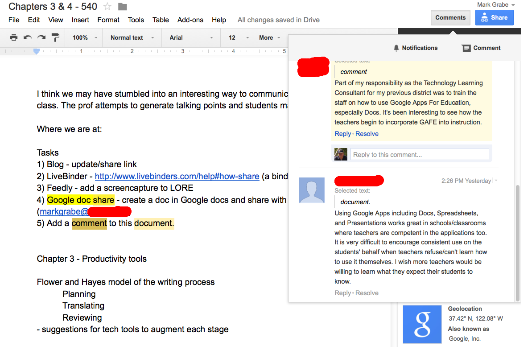
I have stumbled into an approach for advanced classes I like. I run my grad "tech for teachers" class using a kind of flipped model. There are reading assignments and tasks to be completed before class and then the class (online in this case) involves discussion, demonstrations, etc. I typically generate some talking points/notes I provide students at the beginning of class to provide some structure. The outline does not necessarily control the class but it offers some structure in case a structure is needed.
The topic for the week focused on productivity tools, the writing process, peer editing, etc. and one requirement to assure the students had explored the procedure was for the students to comment on a Google doc I had shared. I decided to use the document I was working on for the class outline as the target for the student exercise. The results were pretty interesting. There was no expectation of relevance just the requirement to demonstrate the students could use the comment feature, but the things they decided to add were interesting. I decided the tactic offers some interesting possibilities for the future.

The topic for the week focused on productivity tools, the writing process, peer editing, etc. and one requirement to assure the students had explored the procedure was for the students to comment on a Google doc I had shared. I decided to use the document I was working on for the class outline as the target for the student exercise. The results were pretty interesting. There was no expectation of relevance just the requirement to demonstrate the students could use the comment feature, but the things they decided to add were interesting. I decided the tactic offers some interesting possibilities for the future.
Subscribe to:
Posts (Atom)